
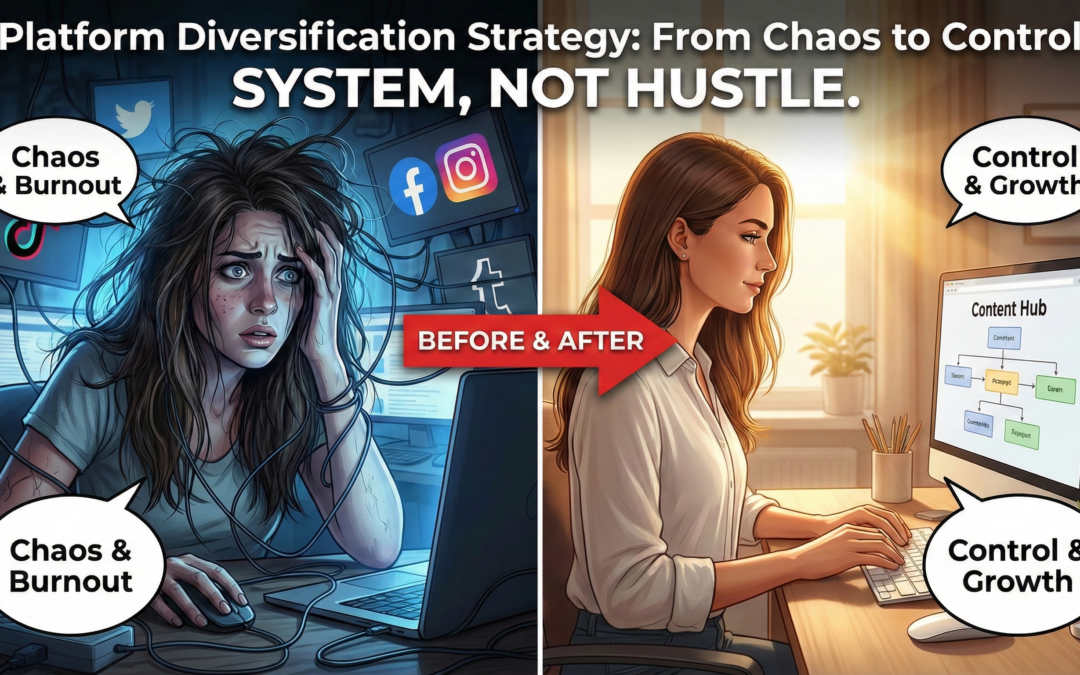
You started the year with ambition. Three platforms? Why not five. TikTok, Instagram, YouTube, Facebook, maybe Twitter—because everyone says you need to be everywhere your audience is, right?
It's February. You're exhausted. Content that performs well on one platform dies on another. You're spending hours reformatting, reposting, and wondering why your engagement is dropping across the board instead of multiplying.
Here's the truth: Multi-platform presence isn't about being everywhere. It's about being strategic about where you show up and how you show up there.
The Diversification vs. Dilution Problem
Most creators confuse platform diversification with platform saturation. Real diversification means building sustainable presence across platforms that serve different purposes in your content ecosystem. Dilution means spreading yourself so thin that you're ineffective everywhere.
The difference comes down to system, not hustle.
When you're posting chaotically across multiple platforms, you're dealing with:
- Fragmented audiences who never see consistent content
- Algorithm confusion because each platform rewards different behaviors
- Creative burnout from trying to be everywhere at once
- Wasted effort reformatting content that wasn't designed to be repurposed
Strategic diversification solves these problems by treating platforms as distinct channels with specific roles, not as identical megaphones for the same message.
Case Study: The Reality Check
Let's walk through Sarah, a composite of creators I've watched struggle with this exact problem.
Sarah's Starting Point (January):
- TikTok: 45K followers, posts 5-7 times weekly, strong engagement
- Instagram: 12K followers, posts Reels 3-4 times weekly, moderate engagement
- YouTube Shorts: 3K subscribers, posts 2-3 times weekly, low engagement
- Facebook: 8K followers, posts randomly 1-2 times weekly, minimal engagement
- Total weekly content output: 15-20 posts across platforms
Sarah's Problem (February):
She's spending 25+ hours weekly on content but seeing declining engagement everywhere. Her TikTok numbers are dropping because she's focused on other platforms. Her YouTube Shorts aren't gaining traction. Her Facebook page is essentially dead. Instagram is plateauing.
She's considering adding YouTube long-form and Twitter to "maximize reach."
This is dilution masquerading as strategy.
The Strategic Framework
Step 1: Platform Audit (What's Actually Working)
Sarah needs data, not feelings. For each platform, we measure:
- Engagement rate (not vanity metrics like follower count)
- Time investment per post/per platform
- Conversion rate (if monetization is a goal)
- Audience overlap (are these the same people or different communities?)
Sarah's Reality:
- TikTok: 8% engagement rate, 45 minutes per video, strong conversion to email list
- Instagram: 4% engagement rate, 60 minutes per Reel (because she's reformatting TikToks poorly), moderate conversion
- YouTube Shorts: 2% engagement rate, 30 minutes per short, almost zero conversion
- Facebook: 1% engagement rate, 15 minutes per post, zero conversion
The Math: She's spending 10+ hours weekly on YouTube Shorts and Facebook combined for less than 3% of her total engagement.
Step 2: Content-to-Platform Matching
Not all content belongs on all platforms. Each platform has a native content style that the algorithm rewards:
- TikTok: Raw, authentic, trend-responsive, entertainment or education with personality
- Instagram: Polished, aspirational, lifestyle integration, visual storytelling
- YouTube Shorts: Quick value, hook-heavy, binge-worthy content
- Facebook: Community discussion, longer-form text, group engagement, evergreen value
Sarah was making the classic mistake: creating for TikTok, then dumping that content everywhere else without adaptation.
The Strategy Shift:
- TikTok remains her primary platform (highest engagement, best conversion)
- Instagram becomes her secondary platform with intentionally designed Reels (not TikTok reposts)
- YouTube Shorts gets cut entirely (low ROI for time invested)
- Facebook shifts from general posting to community building only (2x weekly discussion posts in her group, not on her page)
Step 3: Repurposing Hierarchy
Strategic diversification uses a hub-and-spoke model:
Hub (Primary Platform): Where you create native content - TikTok for Sarah
Spokes (Secondary Platforms): Where you adapt and extend that content
Sarah's new workflow:
- Create 5 TikToks weekly (core content for primary platform)
- Select 3 with highest engagement for Instagram adaptation
- Redesign those 3 for Instagram's visual style (not just repost)
- Pull quotes/insights from top performers for 2 Facebook discussion posts
Weekly output drops from 15-20 posts to 10 posts, but each one is platform-appropriate.
Step 4: Sustainable Posting Cadence
Consistency beats frequency. Always.
Sarah's chaotic schedule was killing her algorithm performance on every platform because she'd post 7 times one week, then disappear for 5 days.
New Cadence:
- TikTok: 5x weekly (Monday/Tuesday/Thursday/Friday/Saturday)
- Instagram: 3x weekly (Tuesday/Thursday/Saturday - 24 hours after TikTok posting)
- Facebook: 2x weekly (Wednesday/Sunday - discussion posts)
Notice the spacing: Instagram content posts after TikTok to capture engagement data and adapt winners. Facebook posts mid-week and weekend to maximize group discussion time.
Step 5: Success Metrics That Matter
Sarah was tracking the wrong numbers. Follower count made her feel like she should be on more platforms. Engagement rate would've told her to cut platforms months ago.
New Dashboard (weekly tracking):
- Engagement rate per platform (target: maintain or grow)
- Time invested per platform (target: reduce without losing engagement)
- Conversion events (email signups, product clicks, whatever matters to your business)
- Revenue per platform (if monetized)
After 30 days on the new system, Sarah's metrics shifted:
- TikTok engagement: 8% → 10% (more consistent posting, better algorithm favor)
- Instagram engagement: 4% → 6% (platform-appropriate content)
- Facebook engagement: 1% → 5% (community discussion vs. broadcast posting)
- Weekly hours: 25 → 14
- Email conversions: up 40%
The Hard Truth About Platform Selection
Here's what most creators don't want to hear: You might need to quit platforms.
If a platform isn't serving your goals, eating your time, and delivering minimal results, it's not "building for the future"—it's opportunity cost. Every hour you spend on a dead platform is an hour you're not investing in platforms that actually work.
When to cut a platform:
- Engagement rate consistently below 2% despite 90 days of consistent, platform-appropriate posting
- Time investment exceeds 20% of your content hours but delivers less than 10% of your results
- Audience overlap is 90%+ with another platform where you perform better
- Zero conversion to your actual business goals after 6 months
When to add a platform:
- You've maximized your primary platform (consistent posting, strong engagement, clear systems)
- You have 5+ hours weekly to invest in building new platform presence
- The new platform reaches a genuinely different audience segment
- You have content that naturally fits that platform's native style
Building Your Own Framework
Sarah's situation won't be your situation, but the framework applies universally:
- Audit ruthlessly - Measure engagement rate and time investment across every platform
- Identify your primary - Where does your content perform best with least friction?
- Choose 1-2 secondaries maximum - What platforms complement (not duplicate) your primary?
- Cut the rest - Yes, really. At least temporarily.
- Design platform-specific adaptations - Stop posting identical content everywhere
- Create sustainable cadence - Consistency over frequency
- Track what matters - Engagement rate and conversion, not follower count
The February Reality Check
If you started the year planning to conquer five platforms and you're already feeling the strain, you're not failing—you're learning an expensive lesson about dilution vs. diversification.
The creators who win at multi-platform presence aren't the ones posting everywhere constantly. They're the ones who identified their leverage points, built systems around them, and said no to everything else.
Your content deserves better than chaotic cross-posting. Your audience deserves platform-appropriate content. And you deserve a sustainable workflow that doesn't burn you out by March.
Strategic diversification isn't about doing more. It's about doing less, better, in the right places.