I want you to think back to when you first started.
Not the grind phase. Not the "I need to figure out the algorithm" phase. Before all that. The very beginning — when you made your first video, posted your first piece, recorded your first episode, and the only person you were really making it for was you.
When did that change?
I've been sitting with a research paper lately — a real academic study out of NYU and INSEAD published in 2025 — and it confirmed something I've suspected for a long time but never had clean language for. The researchers spent years interviewing over 50 creators with hundreds of thousands of followers. Visual artists on Instagram. Musicians on YouTube. People who by any outside measure had "made it."
And almost every single one of them described the same quiet crisis.
They didn't lose their audience. They lost themselves in it.
What the Research Actually Found
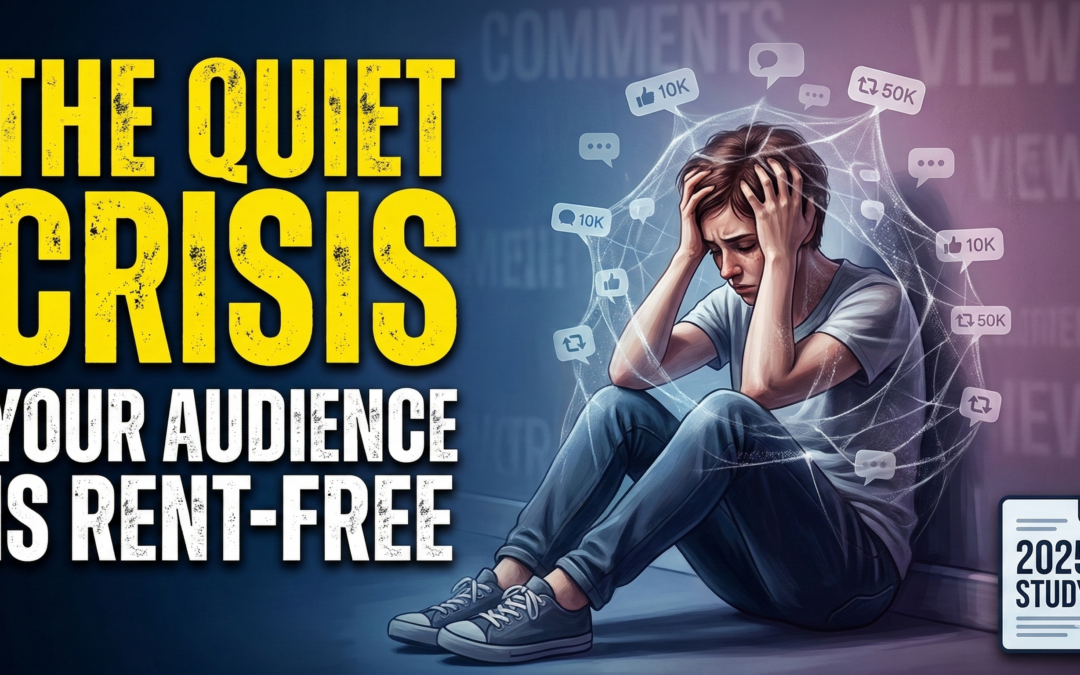
The researchers called it audience entanglement — the idea that once you build a real following, your relationship with that audience becomes a persistent force in every creative decision you make. It's not just "reading comments." It's something deeper. The audience starts living rent-free in your head while you're creating. You start pre-editing your ideas through their eyes before you even make the thing.
Sound familiar?
Here's what hit me hardest about the study. Getting a big audience doesn't solve the problem most creators think it solves. It trades one set of problems for a completely different one.
Before you have an audience, the challenge is clear: make good stuff and get it in front of people. That's hard, but the direction is obvious.
After you have an audience? The challenge flips. Now every post is a referendum. Every dip in engagement is a question about whether you're still relevant. You're not just creating anymore — you're managing a relationship with thousands of people who have expectations, and the platform is feeding you real-time data on whether you're meeting them.
That's a lot to carry while trying to actually make something good.
The Part Nobody Warns You About
The researchers found that most creators go through what they call dysfunctional entanglement first — a state where the audience relationship starts to feel oppressive. You're obsessing over metrics. Negative comments wreck your week. You start making safer content because you're afraid of getting it wrong.
One creator in the study described it as a "chamber of despair."
Another said he had become "an addict of my followers."
That's not weakness. That's what the system is designed to produce.
There's a Way Through It
The good news — and there is real good news — is that the same study found creators who worked through it. They developed specific strategies to move from that dysfunctional state to something healthier. Something sustainable. Where they could still care about their audience without being owned by them.
Next week we're going to dig into the first of those strategies — the most practical one, and the one I've personally seen work inside this community.
But before we get there, I want to hear from you.
When did the numbers start to feel like a report card on your worth as a creator? Was there a moment? A threshold you crossed? Or did it just creep in slowly without you noticing?
Drop it in the comments. No judgment — this is exactly the kind of thing this community exists to talk through.
Research reference: Pillemer, J., Harrison, S., Murphy, C., & Park, Y. (2025). Audience Entanglement: How Independent Creative Workers Experience the Pressures of Widespread Appeal on Digital Platforms. Administrative Science Quarterly.