There's a moment every maker knows.
You're watching someone else's work — a print that came out perfect, a laser cut that's clean down to the last detail, a prop build that looks like it came off a Hollywood set — and the first thing you think is: what machine did they use?
Not what technique. Not how many failed attempts led to that one. Not how many hours they spent learning the material before the material started cooperating.
The machine.
It's almost a reflex. We assume the gap between their work and ours is equipment. We scan the video description for specs. We read the comments hoping someone asked. And if we find out they're running a machine we don't have, something in us relaxes — like we've been let off the hook. Of course it looks like that. They've got the good stuff.
Here's the thing nobody wants to say out loud: that's almost never the real reason.
The Comfortable Lie We Tell Ourselves
Gear Acquisition Syndrome — GAS — is real, and it costs more than money.
Yes, it hits your wallet. A resin printer upgrade here, a new laser module there, the "better" filament that's definitely going to fix your layer adhesion problems. It adds up faster than most of us admit.
But the bigger cost is time. Every hour spent researching the next tool is an hour not spent getting better with the one you have. Every upgrade purchased to solve a problem that's actually a skill problem just delays the reckoning. The problem follows you to the new machine. Sometimes it gets worse, because now you've got a more capable tool and you still don't know how to use it well.
And underneath all of that is something subtler: GAS gives you a reason to not be good yet. As long as the right tool is still coming, you don't have to reckon with where you actually are. It's a comfortable holding pattern that feels productive because you're doing research, you're investing in your craft, you're being serious about this — when really you're just not making things.
The new tool feels like progress. Most of the time, it isn't.
What the Skill Gap Actually Looks Like
Ask any maker who's been at it for years what actually improved their work. The honest ones don't lead with equipment. They talk about the print that failed twelve times before they figured out the bed leveling. The laser job that scorched everything until they finally understood power-speed relationships for that specific material. The prop that looked terrible until they stopped copying tutorials and started thinking through the problem themselves.
Skill isn't one thing. It's a collection of things that compound slowly and don't show up until they do.
It's material knowledge — understanding how your filament behaves at different temperatures, what resin does in the cold, how different woods respond to the laser, why the same settings that worked yesterday aren't working today because the humidity changed.
It's design thinking — knowing what the thing needs to do before you know how to build it. Thinking about tolerances, assembly order, failure points. Asking the right questions before you hit print.
It's troubleshooting instinct — the ability to look at a bad result and have a theory about why. This one takes longer than anything else to develop and can't be bought at any price.
It's patience with iteration — accepting that the first version is a draft, that good work is almost always the result of making the thing twice, and that failure is data, not defeat.
None of that lives in the tool. All of it lives in you. And the only way to build it is to make things — specifically, to make things that don't work out and figure out why.
When Gear Actually Matters
Being honest means saying this clearly: tools do matter. This isn't an argument for suffering through bad equipment forever, or for pretending that a $150 printer and a $1,500 printer produce identical results. They don't.
There's a legitimate version of upgrading. It looks like this: you've pushed your current tool to its actual limits. You know what those limits are because you've hit them repeatedly. You understand exactly what capability you need next and why. The upgrade is a response to growth, not a substitute for it.
That's different from buying the better machine because your prints look bad and you're not sure why. Or because someone on YouTube made it look easy and they have a different brand. Or because you've had the entry-level version for three months and you're already eyeing the pro model.
The test is simple: could you produce significantly better work with your current tool if you knew more? If the answer is yes — and it almost always is — that's where to invest first.
How to Actually Close the Skill Gap
This part isn't complicated. It just requires more discipline than adding something to a cart.
Make more things. Not more research. Not more planning. More actual objects, prints, cuts, builds. Volume is how skill accumulates. Every maker who is genuinely good at what they do got there by making an embarrassing number of things, most of which didn't come out the way they wanted.
Finish things. The half-done project sitting on your workbench isn't building skill. Finishing it — even if it's not quite right — teaches you something the abandoned version never will. Completion is a skill too.
Let things fail on purpose. Change one variable. See what happens. Learn what that material does at the edge of its tolerance. The makers who truly understand their tools are the ones who've broken them on purpose enough times to know exactly what breaks them.
Learn from people, not just tutorials. A tutorial shows you what worked for one person in one situation. A conversation with another maker who's been in your exact spot teaches you how to think about the problem. That's why community matters — not for the validation, but for the compression of learning.
Audit honestly. Look at your last five projects. Where did they fall short? Was it actually a tool limitation — meaning you literally could not achieve that result with your equipment — or was it a knowledge and skill limitation? Be ruthless here. Most of the time, it's the second one.
The Maker Who Sticks With It
There's a maker in almost every community who isn't running the flashiest setup. Their workspace is practical, not impressive. Their tools are mid-range at best. But their work is consistently good — sometimes better than people running equipment that costs three times as much.
What they have isn't gear. It's hours. It's failures they learned from. It's a bone-deep understanding of their materials and their machines because they stayed with them long enough to actually know them.
That's not a romantic notion. It's just what skill looks like when it's had time to develop.
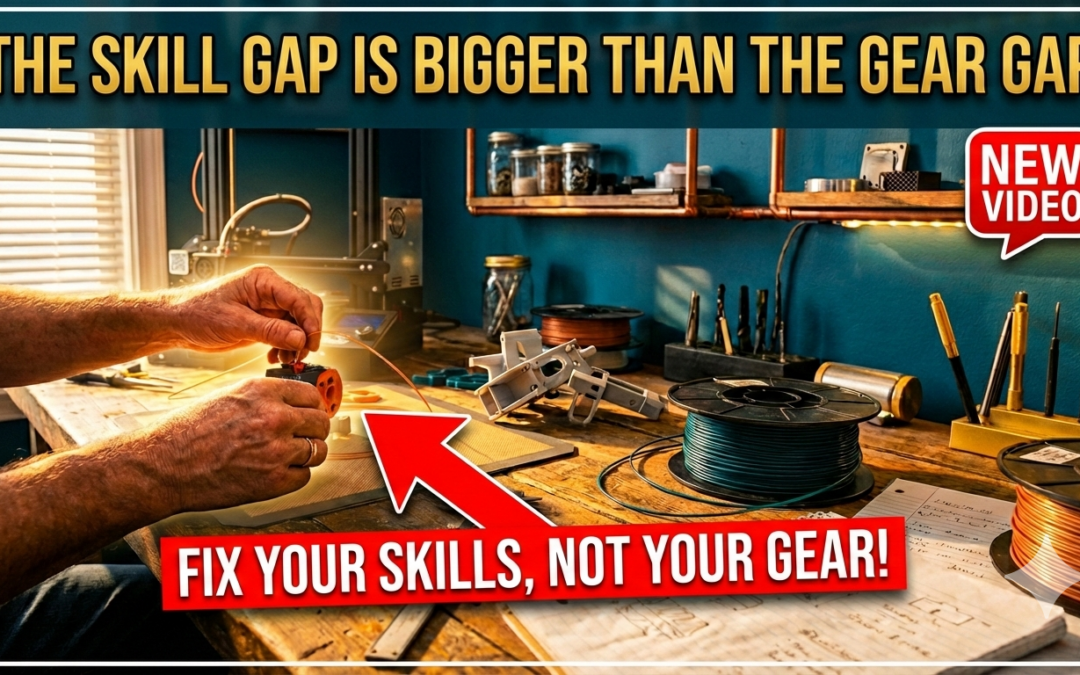
The gap between where you are and where you want to be is almost certainly not a gear gap. It's a skill gap. And the only thing that closes it is making things — with the tools you have, right now, even when the results aren't what you hoped for.
Especially then.
Your Turn
We want to see it.
Drop it in the comments: what's the best thing you've ever made with your most basic setup? The scrappy build. The print from the printer everyone told you was a mistake to buy. The thing that came out better than it had any right to.
Show us what skill looks like.